
A
ASO
ASO stands for Amaury Sport Organization, the organizers of the Dakar Rally. The original founder, Gilbert Sabine, sold the rights to the rally to the Amaury Group in 1993 under the name the Thierry Sabine Organization (TSO). Following a restructuring in 2002, responsibility for the Dakar Rally was transferred to the ASO Motor Sports Division, and from 2003 ASO became the official organizer.
Assistance (Back-up) Class
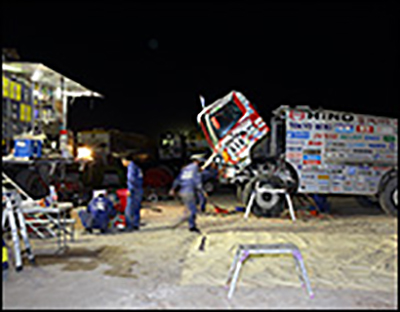
Back-up teams normally follow a different route to the race vehicles as they travel from one bivouac to the next to provide support services. Since contestants can only receive support from other contestants and mechanics who have been registered as assistance staff, these assistance staff play a crucial role in the make-up of the team. In the past, so called “air mechanics” were allowed to fly into bivouacs by plane, but this was banned in 2002 except for on rest days, and this has now been abolished altogether.
Assistance route
Assistance vehicles travel a different route to the race vehicles. The route is set out by the rally organizers beforehand, and follows sealed roads where possible. Detours are often required in order to reach the bivouac points, making the assistance route longer than the race route. In remote areas, assistance vehicles are occasionally required to use the same route as the SS race vehicles. Since they are not permitted to leave the bivouac until all the race vehicles have departed, the race among the assistance vehicles to reach the next bivouac can be as fierce as the competition rally itself.
Assistance vehicles and trucks
Assistance vehicles are used to transport key personnel such as mechanics and managers, while assistance trucks carry large quantities of spare parts, tires and other materials. Assistance trucks are also fitted with equipment such as power generators and air compressors. At night, the bivouac becomes a hive of frenetic activity under night lights surrounded by a circle of trucks.
B
Bivouac
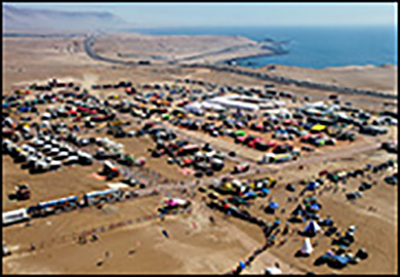
The bivouac is the place where participants camp for the night. Every day in the Dakar Rally starts and ends at a bivouac. There are close to 4,000 people in a bivouac, including competitors, mechanics, team staff, rally officials, medical staff and press representatives. The Dakar Rally bivouac appears over night like a traveling village following the race. A catering team accompanies a bivouac to provide meals for those involved, and there is even a trash collection team. Bivouacs are usually set up in or near an airport as organizer executives, members of the press, and other individuals who are not actually competing in the rally move from bivouac to bivouac by helicopter or plane.
Bogging
Bogging occurs when a vehicle gets stuck in sand or mud and is unable to move due to the resistance of the sand against the tires. Once a common occurrence on the desert stretches of the Paris-Dakar rally, bogging has become less frequent in recent years thanks to CTIS and other performance improvements.
Briefing
Briefings are where rally officials provide participants with important information about the next day’s stage, the schedule, and any changes or developments. Briefings are held every evening, normally at 9 p.m. at the bivouac. Information is provided in French, English and Spanish.
Bush
This refers to low bush groves. Many of the bushes found in the drylands of South America tend to be hard and covered with thorns. The bushes that are often found in semi-desert areas are called “camel grass.”
C
Camion
Camion is the French word for truck (including ordinary road trucks as well as the racing camions featured in the Paris-Dakar).
Check Point (CP)
CP is used to check that participants are following the designated route. Usually, three or four checkpoints are set up along each SS, and sometimes along liaison routes as well. At checkpoints, contestants hand over a card that they received at the start to one of the organizer staff to have it stamped. Heavy penalties are applied if a vehicle does not clear a checkpoint, so ensuring that the vehicle reaches the checkpoint is an important task of the navigator.
Common Rail System
This refers to a form of fuel injection system that is equipped with a common rail where pressurized fuel is accumulated, and a fuel injection unit (injector) that supplies this fuel uniformly to the engine. Equipped with an electronic control unit that is capable of finely controlling fuel injection pressure, timing, and the number of injections, this type of system is instrumental to improving a diesel engine’s fuel efficiency. According to our best information, HINO TEAM SUGAWARA was the first team to employ this system in the Dakar Rally.
CTIS
CTIS stands for Central Tire Inflator System, a system which is used to regulate tire pressures while the vehicle is moving. CTIS allows the driver to prevent blow-outs and bogging by adjusting the tire characteristics to suit different types of terrain such as sand dunes and desert country.
D
Dine
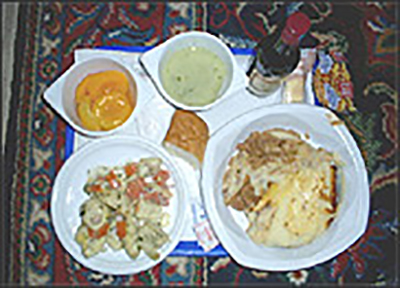
Dine is French for dinner, a time of rest for the hardworking Dakar Rally competitors, when friends can gather together over plates piled high with delicious food and discuss the day's events over a glass of wine. The bustling cafeteria facilities serve meals such as pickled entrees, main dish of meat, hot soup, bread, cheeses and deserts, complemented by wine, beer, soft drink and other beverages.
F
Fesh-Fesh
This refers to terrain covered with sedimentation composed of powdery sand. These can be found all over South America, creating conditions of near-zero visibility caused by dust kicked up by preceding race vehicles. If a car covered in fesh-fesh goes through a puddle of water, the powdery sand mixed with water can find its way into the small gaps and openings of the vehicle’s components, potentially causing breakdowns when the mixture hardens.
FIA
FIA stands for Federation Internationale de l’Automobile, the largest automobile association in the world. Based in Paris, the FIA is responsible for other motor sports such as F1 and WRC.
Since there are currently no other large-scale rally events for trucks, ASO is responsible for the planning and implementation of race car regulations for the trucks category.
G
GPS
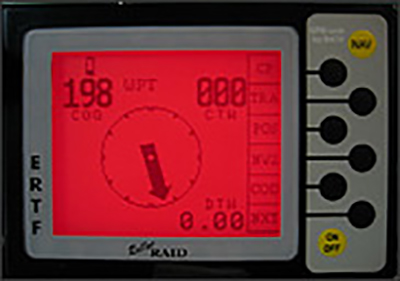
GPS (Global Positioning System) is a positioning system similar to modern car navigation systems, using a satellite signal to determine the location and orientation of the vehicle. To prevent teams gaining an unfair advantage, the Dakar Rally participants are only allowed to use a simple GPS device stipulated by the rally organizers. This system records when and at what speed the contestant’s car passed a point. Penalties are given if a violation is found. The designated GPS device does not provide a map display like a normal car navigation system, and is really little more than a supplementary navigation aid.
Gravel
Gravel roads. In the parlance of motor sports, this refers to unpaved roads.
H
Homologation
The word homologation means to sanction or recognize a vehicle or vehicle prototype. In the context of the Paris-Dakar rally, it means an approved mass-market vehicle that has been accredited in accordance with FIA standards. The standard differs between categories; the minimum production run for camions, for instance, is 15 vehicles.
L
Liaison
The word liaison refers to an untimed section of the Dakar rally route. For safety and security reasons, it is not always possible to begin and end the SS at the bivouac sites. In this case, race vehicles must proceed from the bivouac site to the SS start point, complete the SS, then proceed from the SS end point to the next bivouac. The sections before and after the SS are referred to as liaison sections. Liaison sections are subject to time limits (with corresponding penalties), although these are not too demanding.
Loop stage
A loop stage is a stage that begins and ends at the same bivouac site. To ensure that competitors complete the course as required, penalties for failure to pass through checkpoints are higher on a loop stage. Meanwhile, assistance teams remain at the bivouac and enjoy a well-earned rest.
M
Marathon Stage
The Marathon Stage is a stage lasting for two consecutive days during which time assistance vehicles are prohibited. The aim is to eliminate the difference between the generously resourced corporate teams and the private or individual competitors. However, competitors are allowed to help one another out, which still gives the corporate-backed teams an advantage. To address this problem, the 2005 event introduced a Super Marathon Stage in which vehicles were impounded in a Parc-Fermes as soon as they arrive at the bivouac.
N
Neutral Zone
This refers to sections between SSs (special stages) in cases where a single stage is divided into more than one SS. The race cars are not clocked in neutral zones, and they travel under the same conditions as on liaisons, but they are not able to receive support due to the brevity of the allotted time.
P
Parc-Fermes
The term Parc-Fermes refers to temporary holding of a race vehicle by the rally organizers, and also to the place where vehicles are held. Neither racers nor mechanics are allowed to touch vehicles once they are stored in the Parc-Fermes. Random checks are also conducted here to determine whether any of the race cars are in violation of regulations.
Penalties
The race rules provide for a range of penalties, most of which are expressed as time penalties added to the SS times. The penalty for failing to pass through a checkpoint, for instance, is several hours added to the race time. Severe violations of the rules can result in fines or even disqualification.
Piste
French for “track” or “rut.” Going off-piste refers to the act of leaving these traveled roads or going off-road.
Podium
This refers to the podium where teams are recognized for their performance. At the climax of the Dakar Rally, the Finale Event, prize winners as well as finishing contestants are invited to the podium to be recognized. Contestants are not officially recognized as having finished the rally until they pass the podium, so any race car that becomes immobile while making its way to the podium is disqualified. While it usually takes well over 10 hours for all contestants to pass the podium, passionate South American fans at the podium continue to share their excitement with the racers until the last car arrives.
Q
Quick Assistance
Quick Assistance vehicles are support vehicles that are permitted to enter the race class during an SS when a race vehicle is experiencing mechanical problems. The top corporate teams use highly maneuverable four-wheel drive vehicles backed by trucks carrying spare parts. Assistance trucks are not allowed to support race vehicles in an SS, but they are allowed to do so if they are traveling on the same liaison route as the race vehicle.
R
Road book
The road book shows the route details for the following day, together with a simple chart known as a cell map. Competitors are required to adhere strictly to the designated course, which means plotting the route in accordance with the road book. However, the only information provided in the road book is the destination and the distance. Plotting the route is a difficult task that requires a good deal of experience. Thus, navigation skills are a vital component of the Dakar experience.
S
SS
SS is short for Special Stage, also known as Selective Sector. Each SS is like a time trial. The race results are based on the sum total of the various SS times, minus penalties where applicable. The fastest vehicle is the winner.
Stage
A stage, also known as an etape, is the schedule for a single day of the Dakar Rally. Normally, a stage consists of liaison sections and the SS. A typical stage includes a liaison section from the bivouac to the SS start point, then the SS itself, followed by liaison to the next bivouac. In remote parts with few villages, the SS may take up the entire day.
W
Wadi
This means “dry riverbed” in Arabic. These turn into rivers during the rainy season.
Waypoints
Waypoints are points that contestants are required to pass in addition to checkpoints. These are part of a set of controls set up by the organizers primarily for the purpose of keeping contestants out of the way of hazards. When a race car approaches a waypoint, the GPS monitor starts up and displays the direction and distance to the point. There are two types of waypoints: a hidden waypoint (WPM, or “waypoint mask”) and a waypoint safety (WPS). With a WPM, the GPS starts up when a race vehicle comes within 800m of the point, and registers the vehicle as having “passed” when it comes within a 200m radius of the point. With a WPS, to keep contestants out of the way of hazards, the GPS starts up at a 3km radius of the point, and registers a vehicle as having “passed” when it comes within 90m of the point. Contestants must pass all waypoints, of which there are usually 40 to 50 per day.