
Environment
Hino positions addressing environmental issues as a theme of paramount importance for management and will continue to cooperate with governments and relevant industries in each country to pursue every measure possible from the perspective of society and our customers.
- Fundamental Approach to Global Environmental Conservation
- Environmental Promotion Systems
- Hino Environmental Strategy
- Disclosure Based on TCFD Recommendations
- Contribution to the Achievement of a Carbon-Neutral Society
- Initiatives for Our Business Partners
Fundamental Approach to Global Environmental Conservation
The Hino Group has set out its fundamental approach to global environmental conservation in the HINO Global Environmental Charter and the HINO Environmental Policy and shares and implements this approach with all employees, including those at related companies.
HINO GLOBAL Environment Charter Formulated April, 1993, Revised February, 2001
Basic Policies
1. We will promote comprehensive and ongoing environmental protection.
As a leading manufacturer of diesel vehicles, we will endeavor to offer superior products to customers in all countries, and continue to contribute to the achievement of greater prosperity through our products. In this, we are fully aware of the environmental impact of our products, and pledge ourselves to an earnest commitment to sustainable human and global development through ongoing efforts, whilst also paying careful attention to preventing pollution wherever we engage in our corporate activities.
2. We will take concrete and definite steps to protect the global environment.
Through the establishment and operation of our Environmental Management System we will maintain continuous efforts to define, assess and review environmental goals and targets while strictly adhering to all legal and other requirements placed upon us.
Action Guidelines
1. We will minimize the environmental impact of our vehicles throughout their life cycles, and of all our corporate activities in general.
We are determined to offer the public products having top-level environmental performance, and to engage in continuous technical development designed to minimize the environmental impact of our products and their distribution. We will also engage in the establishment and operation of an Environmental Management System embracing all stages in the life cycle of our vehicles.
2. We will develop closer partnerships with our affiliated companies.
The cooperation of a great many companies is critical for the effective pursuit of our business activities. We will work closely with vehicle manufacturing partners both in Japan and abroad, and will strive to extend the mutual range of our environmental protection efforts.
3. We will make greater efforts in the areas of information disclosure, education and awareness-promoting activities.
We will engage in activities designed to disseminate to as many people as possible a correct and proper understanding of what we are trying to achieve. At the same time, we will spare no effort to hone our own environmental sensitivity.
4. Our contribution is not limited to the offering of superior products.
As corporate citizens, and as a corporate entity existing within a local community, we will take an active part in a broad range of community and social activities.
HINO Environmental Policy Formulated June, 2023, Revised September, 2025
Action Guidelines
1. Compliance with laws and regulations
We will provide our products and services by complying with applicable environmental
laws and regulations* as well as appropriate voluntary rules and best practices regarding the
environment.
*This refers to all applicable laws and regulations in countries and regions where Hino develops its
business or sells its products, including but not limited to the Japanese Air Pollution Control Act,
Automobile NOx and PM Act, and the U.S. Clean Air Act, and other U.S. environmental laws and
regulations.
2. Prevention of environmental pollution
We will prevent environmental pollution caused by oil and chemical substances, reduce the impact of these pollutants, reduce emissions of air pollutants, and reduce and properly manage hazardous waste and wastewater.
3. Creation of a sustainable society
We will promote our “Annual Company-Wide Environmental Activity Policy,” which was formulated based on the Environmental Initiative Plan and by backcasting the HINO Environmental Challenges 2050 and the HINO Environmental Milestone 2030.
4. Maintenance of environmental management
We will formulate an environmental conservation promotion plan, review it periodically, and continuously improve it to achieve our goals.
5. Participation of all employees
We will develop and maintain an environmentally-oriented culture that encourages all employees of Hino to take an interest in the environment and requires employees to comply with applicable environmental laws and regulations.
Environmental Promotion Systems
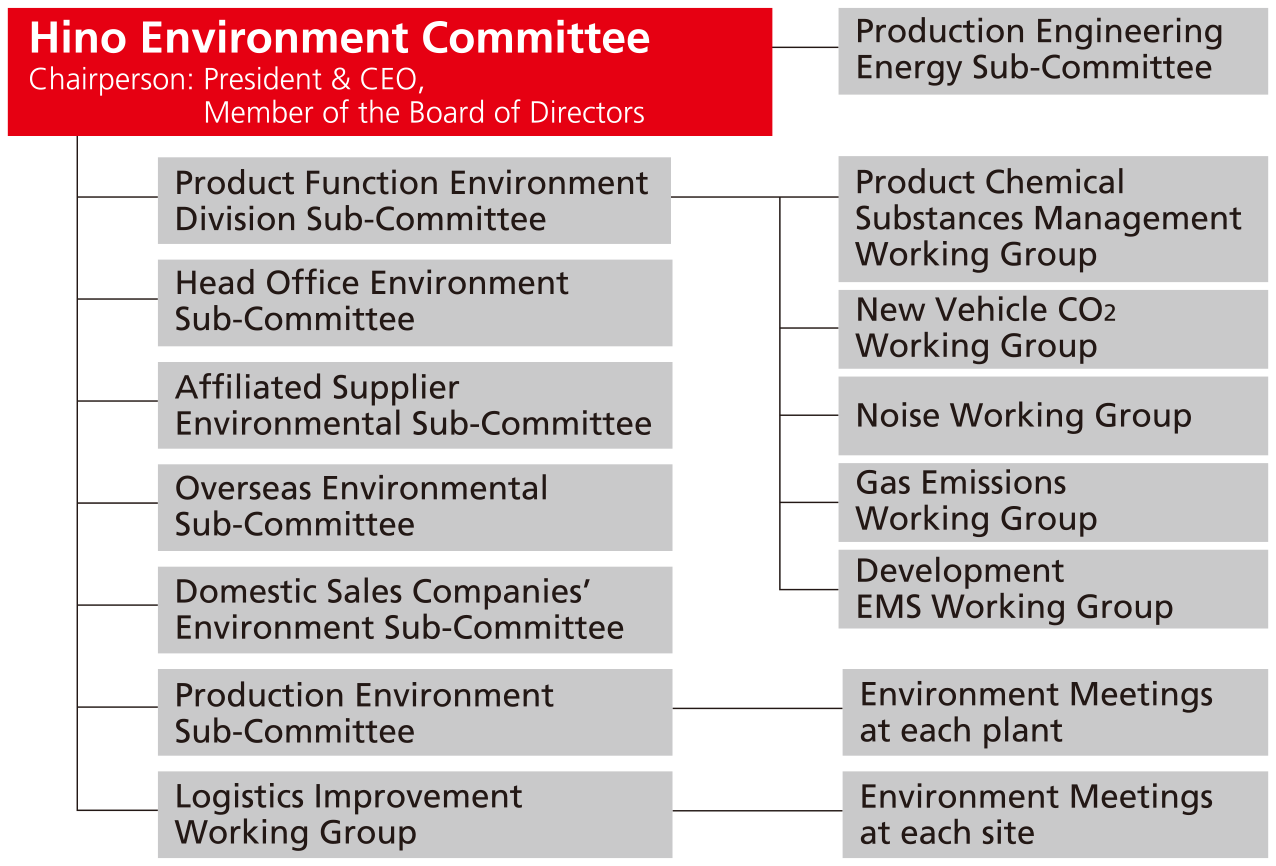
Chaired by the President & CEO, the Hino Environment Committee convenes four times
annually to evaluate the progress of efforts for the planning and formulation of our medium- to long-term
environmental strategy. The progress of our strategy and of initiatives such as the introduction of
renewable energy, which have an impact on our operation, are discussed and decided on by the Management
Committee and the Board of Directors.
Additionally, seven subcommittees have been established as subordinate organizations of the Hino Environment
Committee, and are promoting initiatives aimed at reducing environmental impact throughout our businesses.
Hino Environmental Strategy
Hino has formulated the “Hino Environmental Challenge 2050” and its medium-term environmental target “HINO Environmental Milestone 2030” and is moving ahead with activities intended to address global environmental issues. Additionally, we have established a 5-year action plan, the “2025 Environmental Initiative Plan,” and are working to achieve a sustainable society.

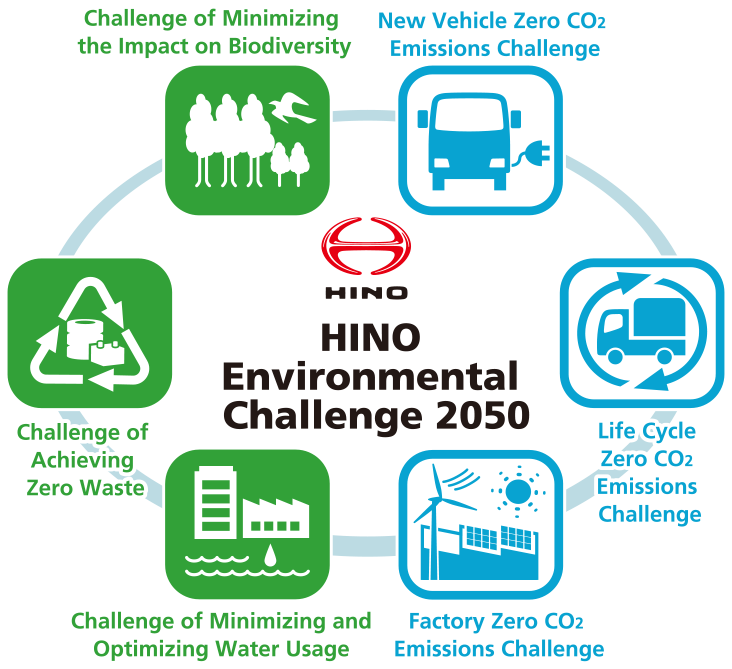
Hino Environmental Challenge 2050
Hino formulated the Hino Environmental Challenge 2050 in 2017. It has declared the Six Challenges that the Hino Group should achieve in order to leave an affluent, comfortable world for future generations, and is promoting initiatives to that end.
Major Initiatives
We believe that trucks and buses have an impact on the environment throughout the product lifecycle from the manufacture of parts and materials to vehicle production, use by the customer, and then disposal. As a company that supports the transportation of goods and people, which are the lifelines of society, Hino is working to address a range of problems facing the global environment, such as worsening global warming, water shortages, resource depletion, and environmental destruction.
HINO Environmental Milestone 2030
The HINO Environmental Milestone 2030 has been designated as its medium-term environmental target on the way to achieving the goals of the HINO Environmental Challenge 2050. Hino has positioned becoming carbon neutral as the most important issue confronting us and is promoting initiatives to achieve this goal. As we move forward with these efforts, we will collaborate with governments and related industries in each country in pursuing and implementing a range of measures from the perspective of society and our customers.
Global activity targets
This table can be scrolled horizontally
| Hino Environmental Challenge 2050 | HINO Environmental Milestone 2030 targets | Major initiatives |
|---|---|---|
|
New Vehicle Zero CO2 Emissions Challenge |
40% reduction compared to FY2014 in global average CO2 emissions during product operation |
- Develop and deploy electric vehicles - Improve diesel consumption - Initiatives for improved transportation efficiency |
|
Life Cycle Zero CO2 Emissions Challenge |
25% reduction compared to FY2014 in global average CO2 emissions in product lifecycles |
-Reduce CO2 emissions throughout the product lifecycle -Promote decarbonization of manufacturing processes |
|
Factory Zero CO2 Emissions Challenge |
40% reduction compared to FY2014 in CO2 emissions from factories |
- Introduce innovative technologies - Promote daily improvements - Introduce renewable energy |
|
Challenge of Minimizing and Optimizing Water Usage |
- Water saving and recycling with consideration of local water risks -Thoroughgoing management based on our rigorous criteria, leading to preservation of the water environment |
- Use small amounts of water - Return purified water to nature |
|
Challenge of Achieving Zero Waste |
30% reduction compared to FY2019 in waste from factories |
- Reduce to reach zero waste - Increase in resource utilization efficiency |
|
Challenge of Minimizing the Impact on Biodiversity |
Create plants that coexist in harmony with nature* *Factories promoting activities that take regional characteristics (ecosystems) into account |
- Conserving biodiversity - Providing learning opportunities |


Primary measures and contributions towards achieving the SDGs (Sustainable Development Goals)
Minimizing environmental burden at each step in the truck and bus business
Hino will contribute to the prevention of global warming, resource recycling, and the conservation of biodiversity through the Hino Environmental Challenge 2050, an initiative that reduces the environmental impact of trucks and buses on the planet to an absolute minimum.
Constructing a sustainable value chain
Hino will contribute to the achievement of a sustainable society with little environmental impact by minimizing the effect on society and the environment across the broad-ranging truck and bus value chain.
Creating a community of like-minded members
(Leveraging all possible capabilities to address social issues)
In addition to the Hino Group, we will partner with other companies who share our aspirations to address social issues.
2025 Environmental Initiative Plan
Hino instituted the 2025 Environmental Initiative Plan, a 5-year plan, in 2021 with a view
to achieving the company’s medium- and long-term strategies. Under this plan, the company has defined goals
and plans that it works towards with regard to the Six Environmental Challenges, compliance with laws and
regulations, and management.
The outcomes of the major initiatives for 2024 are as follows.
Progress on activity targets
This table can be scrolled horizontally
| 2025 environmental initiative plan, plan content, targets, etc. | Major initiatives in FY2025 | |||
|---|---|---|---|---|
| Six Environmental Challenges |
Life Cycle Zero CO2 Emissions Challenge |
Target: Reduce 12% (per unit transportation volume*) compared to FY2014 * CO2 emissions during transport per kilometer for a one-ton load or per kilometer for one person - Reduce CO2 emissions in all processes: manufacturing, transport, use, and disposal (collaborate with each country and industry) |
- Examined the calculation methods and scope for lifecycle CO2 with member companies of
the Japan Automobile Manufacturers Association, Inc. - Assisted business partners with CO2 emissions visualization and shared reduction case studies - Managed CO2 emissions from logistics and promoted emissions reduction activities |
|
|
New Vehicle Zero CO2 Emissions Challenge |
Target: Reduce 15% (per unit transportation volume) compared to FY2014 - Develop and deploy electric vehicles - Improve diesel consumption - Implement initiatives for improved transportation efficiency |
- Carried out minor model change and relaunch of the Hino Dutro Z EV light-duty battery electric
truck - Released the HINO BLUE RIBBON Z EV full-flat BEV route bus - Helped to conduct driving demonstration for fuel cell heavy-duty trucks |
||
|
Factory Zero CO2 Emissions Challenge |
Target: Reduce 30% (total global emissions) compared to FY2014 - Introduce innovative technologies - Promote daily improvements - Introduce renewable energy |
- FactoryCO2 emissions: Reduced by 60% (total global emissions) compared to FY2014 - Utilized waste heat from equipment and made other daily improvements - Used renewable energy in nine consolidated subsidiaries, both in Japan and overseas, through installation of solar panels, purchasing of electricity generated using renewable energy, etc. |
||
|
Challenge of Minimizing and Optimizing Water Usage |
Target: Implement initiatives for efficiently reducing water usage (all plants worldwide) - Use small amounts of water - Return purified water to nature |
- Evaluated water quantity and quality risks - Managed water quality to our own standards, which are even stricter than the legal emissions standards |
||
|
Challenge of Achieving Zero Waste |
Target: Reduce 12% (total global emissions) compared to FY2019 - Reduce to reach zero waste - Use resources from discarded vehicles in newly manufactured vehicles (car to car) - Reduce packaging materials and plastic wrapping materials |
Waste material emissions: Reduced by 41% (total global emissions) compared to FY2019 - Extended life of cutting fluid and made other daily improvements - Waste plastic discharge: 1,417 tons (in-house) - Revised packaging methods for vehicle parts to reduce material usage - Reduction rate for packaging materials per unit of production: Reduced 31% compared to FY2019 - ASR recycling rate: 97% (Legally mandated standard: 70%) Achievements for recycling under the Automobile Recycling Act (Japanese) |
||
|
Challenge of Minimizing the Impact on Biodiversity |
Establish two model plants that coexist in harmony with nature - Create plants that conserve greenery and water, and coexist in harmony with nature |
- Developed biotope and forest, provided learning opportunities to the community (Koga Plant,
HMMT*1) |
||
| Compliance with laws and regulations | Air | - Take measures to prevent air pollution in products and production | - Promoted development of products that comply with upcoming regulations in each market, and
preparations for market entry - Reduction rate per unit of VOC: 17% |
|
| Water quality / Soil quality | - Manage wastewater and prevent underground seepage in the course of production - Prevent the spread of pollution during land transactions and modifications |
- Complied with legal standards - Implemented evaluation and response for all cases - Conducted 5 soil investigations and 1 contamination countermeasure |
||
| Noise / Vibrations | - Reduce noise and vibrations in products and production | - Developed vehicles that comply with all noise laws and regulations - Complied with legal standards at plant site boundaries |
||
| Waste materials | - Properly manage waste materials | - Concluded contracts for waste disposal and managed such materials properly - Concluded six contracts regarding new waste materials |
||
| Chemical substances | - Manage chemical substances and reduce hazardous substances in products and production | - Implemented management of environmentally harmful materials using International Material Data
System from a global perspective - Implemented thorough management of prohibited substances in new subsidiary materials and conducted 454 evaluations |
||
| Accident prevention | - Prevent environmental accidents (goal of zero violations and complaints, defects and reports) | - Two violations and five abnormalities occurred. Appropriate action was taken based on governmental
guidance - Implemented cross-group investigations and general inspections to prevent similar incidents from occurring |
||
| Management | Create environmentally responsible human resources (communicate environmental management and conduct in-house education) | - Held external seminars attended by 110 participants Content: ISO fundamentals, environmental law
seminars, auditing method e-learning - Held study sessions by the Operating Officer, Safety Health & Environment with 130 people attending Theme: "The earth’s functions and mechanisms: Thinking about water" |
||
Disclosure Based on TCFD Recommendations
The Task Force on Climate-Related Financial Disclosure (“TCFD”) was established in 2015 by
the Financial Stability Board at the request of G20 to reduce the risk of financial market instability in
connection with climate change. In June 2017, TCFD published certain policy recommendations to encourage the
consideration of climate-related risks and opportunities in business and investment decisions, as well as to
encourage climate-related financial disclosures. Hino Motors, Ltd. (“Hino”) hereby announces that it is in
agreement with TCFD’s policy recommendations and accordingly discloses the following information with
respect thereto.
The Hino Group endorses the TCFD. In accordance with TCFD guidelines, we perform scenario analysis, identify
the risks and opportunities that are presented to business activities, and deal with the risks and
opportunities of climate change.
Contribution to the Achievement of a Carbon-Neutral Society
Our Approach to Achieving Carbon Neutrality through Business
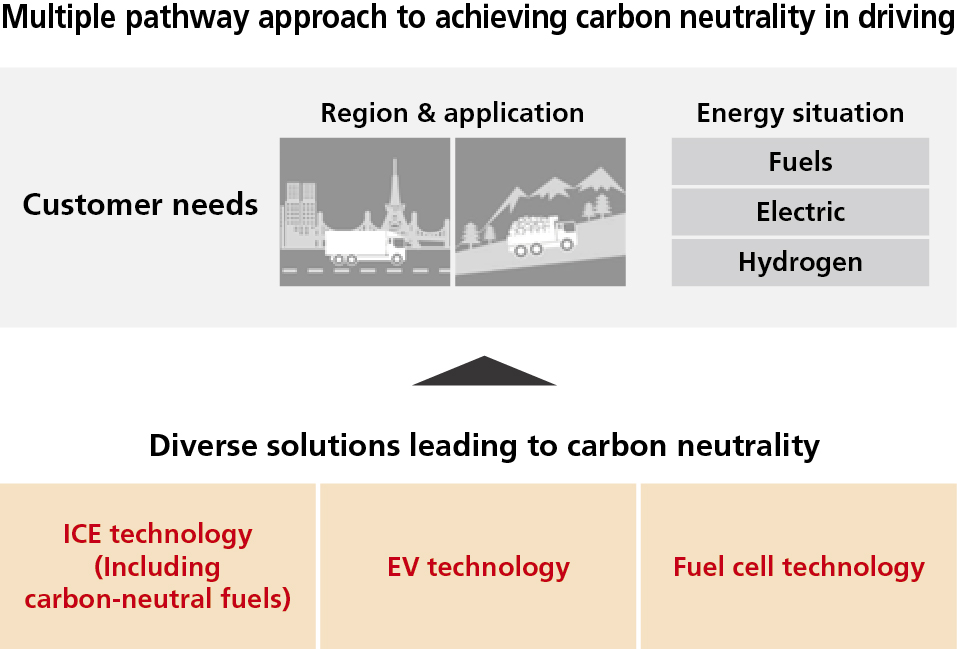
At Hino, we view addressing environmental challenges as a key driver of corporate value. Guided by the Hino Environmental Challenge 2050, we are working toward carbon neutrality (net zero greenhouse gas emissions) across all business activities. In particular, we focus on reducing CO2 emissions throughout the entire life cycle of commercial vehicles, promoting a carbon neutrality strategy built on three pillars: electrification, fuel diversification, and efficiency improvement.
Initiatives for Our Business Partners
Hino is working in cooperation with our business partners to contribute to society and reduce environmental impact, with the aim of achieving a sustainable society. Based on a commitment to legal compliance as a fundamental principle, we are establishing environmental management systems such as ISO14001, and promoting zero CO2 emissions over the entire lifecycle, reduction of water resources and waste, and biodiversity conservation.